




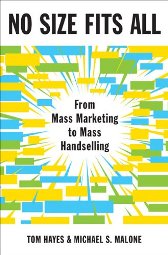
No Size Fits All: From Mass Marketing to Mass Handselling
by Tom Hayes and Michael S. Malone

–Reviewed by Saskia Vogel
 In the movies, all it takes to crack the in-crowd is one savvy make-over. If only it were so easy. In a consumer landscape where every crowd is the in-crowd – and the mass market made of many in-crowds – marketers need to shape-shift constantly, and hock their wares one niche at a time.
In No Size Fits All, Tom Hayes and Michael S. Malone suggest that this isn’t a new way of doing business. The mass market, they argue, is a mere industrial-era blip in the history of commerce. In today’s post-industrial digital age, we’re returning to a culture of “handselling,” that is, to a collection of business practices that date back to the earliest casbah, where merchants pitched their goods one customer at a time. Today’s online casbah is open 24 hours a day, 365 days a year, to anyone who is digitally enabled. In line with Chris Anderson’s “Long Tail” economic theory, this means that for the 80 percent of products that are not the blockbuster hits, the potential customer base is bigger than ever before.
Hayes and Malone take a timely look at how to market to today’s groups, and their argument is palatable even to the technophobe. They claim that we’re playing out pre-historic tribal behavior on a digital stage, still acting like our ancestors who “chose to band together in community rather than go it alone in a hostile world.” Today, people can join as many groups as they desire to suit as many personas as they wish to indulge. The ease with which one can join a group can make most online interactions seem transient and fleeting. Still, Hayes and Malone say, the “value of the social network is defined not only by who’s on it, but by who’s excluded.” Facebook may have hundreds of millions of users, but these users are divided into exclusionary groups – a circle of friends, fans of a particular person or product, groups – that, Hayes and Malone say, are something like sound-proof apartments overlooking Times Square on New Year’s Eve.
That’s not to suggest that Times Square doesn’t matter. The key to “mass handselling” is to find an instantly recognizable image – a logo, a famous face – that appeals to all the small groups in a unique way. Apple has managed to create a simple and unmistakable logo that means cool. And though it is grim to think of 9/11 as a branding moment, Hayes and Malone argue that even Al Qaeda, like Apple, benefits from being associated with the infamous image of planes hitting the World Trade Center. It’s one of the several unorthodox examples of successful marketing for the modern age that drives home the authors’ points – even to those who feel like they’ve heard it all before.
The authors look ahead to the future of mass handselling. There are problems for brands – as McDonald’s menus are more and more tailored to local markets, for example, when does a McDonald’s restaurant stop reflecting the McDonald’s brand? But the future could be especially bright for much smaller sellers. Hayes and Malone imagine a world where indigenous craftsmen can rent web-enabled devices to list their hand-made rugs online, and find a revenue stream where perhaps there was none before. It’s an interesting note for a book on marketing to strike. As sellers and buyers grow ever closer together, marketers can whittle as many new spears as they want. The rest of us have connections to make.
Further Reading: Jump Point: How Network Culture is Revolutionizing Business

Saskia Vogel writes a lot. Visit her at http://SaskiaVogel.com.
*Photo courtesy Tiger Pixel.
Send A Letter To the Editors